


- The Sam Harris essay contains several instances of circular reasoning, where the conclusion is assumed within the premises.
- Harris asserts that well-being is the ultimate basis of morality without adequately justifying this assumption.
- The argument that “science can determine human values” is circular in that it presumes science can define moral truths because it studies human well-being, which is claimed to be the basis of all moral truths.
- The author conflates epistemological objectivity (the unbiased study of phenomena) with the capability to derive objective moral truths.
- The essay argues that well-being provides a universal metric for moral evaluation.
- Many claims in the essay are presented without adequate evidence or logical support.
Table of Contents: (Click any link below to navigate to that section.)
- Critique the following essay on morality. Pay particular attention to circular arguments, illegitimate attempts to reify heuristics into universal principles, and the lack of substantiation for any claim.
- Respond to Sam Harris’ essay above through the lens of the following essay:
- Provide syllogistic renderings of the primary arguments in both essays.
- Quiz
- Provide 15 discussion questions relevant to the content above.


Critique the following essay on morality. Pay particular attention to circular arguments, illegitimate attempts to reify heuristics into universal principles, and the lack of substantiation for any claim.
Podcast Blurb: Sam Harris revisits the central argument he made in his book, The Moral Landscape, about the reality of moral truth. He discusses the way concepts like “good” and “evil” can be thought about objectively, the primacy of our intuitions of truth and falsity, and the unity of knowledge.
Critique of the Essay on Morality
Circular Arguments
The essay contains several instances of circular reasoning, where the conclusion is assumed within the premises.
- Well-being as the Basis of Morality:
The author asserts that well-being is the ultimate basis of morality without adequately justifying this assumption. He states, “Morality and values depend on the existence of conscious minds—and specifically on the fact that such minds can experience various forms of well-being and suffering.” This presupposes that well-being is inherently valuable, but this is the very point that should be proven, not assumed. - Science and Morality:
The argument that “science can determine human values” is circular in that it presumes science can define moral truths because it studies human well-being, which is claimed to be the basis of all moral truths. This is a reification of a heuristic (the empirical study of well-being) into a universal principle (the basis of all moral judgments).
Reification of Heuristics into Universal Principles
The essay frequently attempts to elevate heuristics to the level of universal principles without sufficient justification.
- Epistemological Objectivity:
The author conflates epistemological objectivity (the unbiased study of phenomena) with the capability to derive objective moral truths. While science can describe human behavior and its effects on well-being, this does not necessarily lead to prescriptive moral truths. The leap from descriptive facts to prescriptive norms is not substantiated. - Universal Moral Principles:
The essay argues that well-being provides a universal metric for moral evaluation. However, this assumes a homogeneity in human values and experiences that may not exist. For example, different cultures and individuals might prioritize values such as honor, duty, or spiritual fulfillment over well-being. The essay fails to account for this diversity and simply assumes well-being as universally paramount.
Lack of Substantiation
Many claims in the essay are presented without adequate evidence or logical support.
- Meditation as a Tool for Objective Study:
The author states, “meditation is a crucial tool for doing this,” referring to the objective study of human subjectivity. However, this claim lacks empirical support within the essay. While meditation might provide insights into subjective experiences, its role as an objective scientific tool is not substantiated with evidence. - Moral Certainty:
The author asserts, “we know, to a moral certainty, that human life can be better than it is in a society where they routinely decapitate people for being too rational.” While this is a compelling moral stance, the essay does not provide a robust framework to transition from this moral intuition to a scientific basis for morality. - Critique of Skepticism:
The essay dismisses skepticism about universal moral truths as based on “several fallacies and double standards,” but it does not provide a detailed refutation of these skeptical positions. Instead, it relies on rhetorical questions and assertions that fail to engage with the depth of philosophical skepticism.
Other Observations
- Complexity of Morality:
The essay simplifies the complexity of moral philosophy. By focusing on well-being as the sole determinant of morality, it overlooks other significant moral theories, such as deontology and virtue ethics, which offer valuable insights into moral reasoning. - Science and Values:
The essay conflates scientific objectivity with moral objectivity. While science can inform us about the consequences of actions, it does not inherently provide normative guidance on what we should value or prioritize. - Analogy and Thought Experiments:
The use of analogies and thought experiments, such as the Shallow Pond problem, are helpful but do not conclusively support the thesis. These examples illustrate specific moral intuitions but do not demonstrate that well-being is the foundational principle of all moral reasoning.
Conclusion
The essay attempts to establish a scientific basis for morality by reifying heuristics like well-being into universal principles. However, it lacks robust substantiation for its claims and often resorts to circular reasoning. A more thorough engagement with diverse moral theories and a stronger empirical foundation are necessary to support the thesis that science can determine human values.
Circular reasoning and question-begging
- The author’s central argument for grounding morality in well-being and consciousness is circular. He asserts that “consciousness is the only context in which we can talk about morality and human values,” but doesn’t adequately justify this claim. This assumes the very thing he’s trying to prove – that consciousness and well-being are the proper foundations for morality.
- The claim that “the worst possible misery for everyone is bad” as an irrefutable moral truth similarly begs the question. It presupposes that suffering/well-being is the correct metric for morality, which is precisely what needs to be proven.
- The author argues that we should define morality in terms of well-being just as we define physics in terms of matter and energy. However, this analogy fails because the definition of physics is descriptive, while his proposed definition of morality is prescriptive.
Reification of heuristics and intuitions
- The essay attempts to elevate common moral intuitions (e.g., “suffering is bad”) to universal moral truths without sufficient philosophical justification. The fact that humans generally prefer not to suffer doesn’t necessarily mean this preference constitutes an objective moral principle.
- Scientific values like logical consistency, empiricism, and parsimony are reified into moral values without adequately explaining why scientific epistemology should ground ethics. This conflates epistemology with ethics in a problematic way.
- The author reifies the human cognitive ability to make moral judgments into evidence for moral realism, without considering alternative explanations (e.g., evolutionary psychology).
Lack of substantiation for key claims
- The existence of objective moral truths is asserted without sufficient evidence or argumentation.
- The claim that science can determine human values is not adequately supported.
- The author fails to justify why well-being/flourishing should be the foundation for morality, rather than other proposed foundations (e.g., justice, rights, duty).
- The assertion that consciousness is the only valid context for morality is not sufficiently defended against alternative views.
- The claim that all other moral concerns (e.g., fairness, loyalty) ultimately reduce to concerns about well-being is asserted rather than demonstrated.
Problematic analogies and false equivalences
- The analogy between morality and medicine/health is flawed. Health has clear biological metrics and goals, while morality does not have universally agreed-upon metrics or goals.
- The comparison of moral philosophy to physics in terms of having axioms is misleading. Physical axioms are based on observable, repeatable phenomena, while moral axioms are not.
- The author equates the difficulty of defining causality with the difficulty of justifying moral foundations, which is a false equivalence.
Inadequate engagement with alternative views
- The dismissal of deontological and virtue ethics is cursory and fails to engage with their strongest arguments or most sophisticated formulations.
- The author doesn’t adequately address moral non-cognitivist views or moral anti-realism.
- The essay doesn’t sufficiently engage with philosophical arguments against consequentialism or for moral relativism.
Conceptual and logical issues
- The “moral landscape” metaphor, while evocative, doesn’t solve the core philosophical issues around moral realism vs anti-realism or the is-ought problem.
- The essay conflates descriptive and prescriptive claims about morality in problematic ways, failing to adequately address the is-ought problem.
- The author’s attempt to derive “ought” from “is” by appealing to possible states of consciousness doesn’t successfully bridge the is-ought gap.
- The essay doesn’t adequately address the problem of interpersonal utility comparisons, which is crucial for any well-being-based moral theory.
Methodological problems
- The author relies heavily on thought experiments and intuition pumps rather than empirical evidence or rigorous logical argumentation.
- The essay doesn’t adequately address potential counterexamples to its claims (e.g., scenarios where maximizing well-being might intuitively seem immoral).
- The author’s definition of science is overly broad, potentially making his claim that science can determine morality unfalsifiable.
Unaddressed implications and challenges
- The essay doesn’t adequately address how to resolve conflicts between different people’s well-being or between short-term and long-term well-being.
- The author doesn’t sufficiently grapple with the challenge of moral uncertainty – how we should act given our imperfect knowledge of what maximizes well-being.
- The implications of the author’s view for moral responsibility and free will are not fully explored.
While the essay presents some thought-provoking ideas and challenges to traditional moral philosophy, its arguments often rely more on intuition and assertion than on rigorous philosophical reasoning or empirical evidence. To make a more compelling case, the author would need to more thoroughly justify his foundational premises, engage more substantively with opposing views, and address the numerous philosophical challenges to his position.
Respond to Sam Harris’ essay above through the lens of the following essay:
Every human longs to be the regent of their own kingdom, to bring others under their influence and, if possible, obedience. One way to do this is to co-opt the distortive Manichaeistic notion that there are heavily populated poles of good and evil, and the desire humans have to be considered “good”.

This polarization of human essence along with the reification of “evil” has created a single goal of all would-be regents who would like to rule their social environment. That goal is a claim on the term “immoral”. If you can invoke the term “immoral” in response to behavior, you have a powerful tool to psychologically control others and to establish yourself as “moral” or “good”.
The term “immoral” can be flung around in social dialogue with few humans asking for a rigorous definition of the term since it has developed such strong connotative force. To call someone “immoral” is to say they belong on the opposite pole as the “good” person invoking the term. It is to say they are “evil” with all of the connotative force that vague term carries.
The only thing that remains is to acquire this license to the use of “immoral” in a way that looks legitimate. For this, two things are necessary. The first is the introduction of a moral realm to society’s ontology. The second is the construction of a moral system that has the look of plausibility.
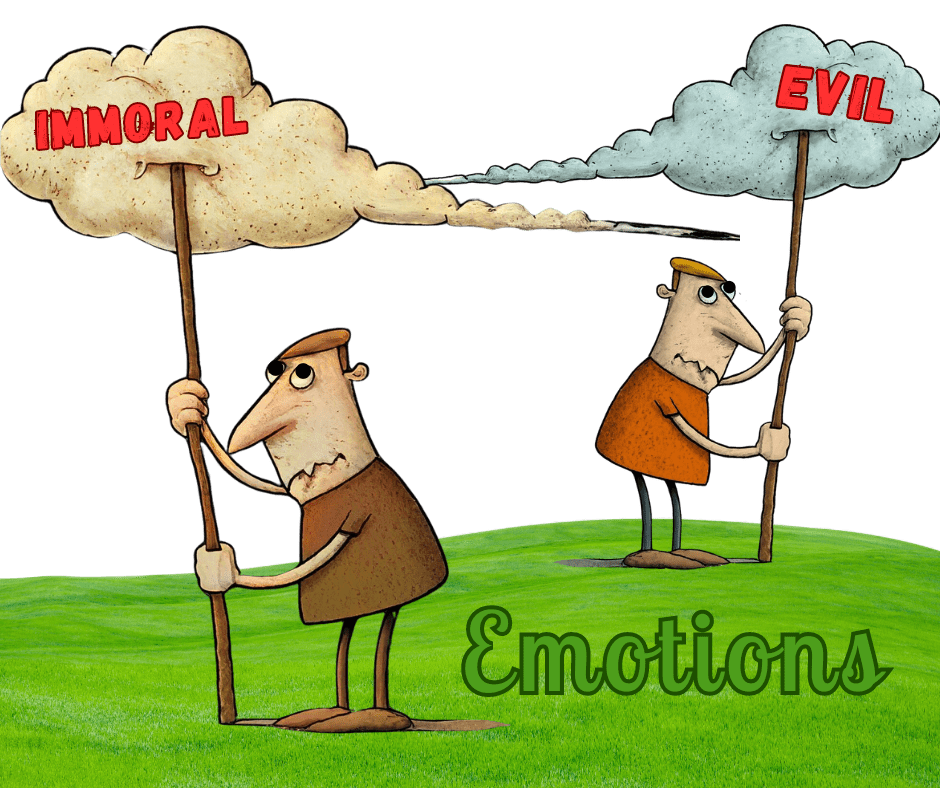
The addition of a moral realm to society’s ontology does not take much effort. Every human hopes to be a regent with control over others. This can be done on a more basic level by simply invoking emotions. However, saying you find something “abhorrent” feels inadequate. Humans want something beyond emotions with a bit more “oomph”, something with the feeling of compulsion or obligation. So suggesting there is something more than emotions in a transcendent realm we call “morality” is a fairly easy sell despite the absence of arguments that would legitimate its addition to our ontology.
We now arrive at the art of constructing moral systems. These will be moral systems that have two features. First, they must roughly map to human emotions. If they run counter to common human emotions, the moral system will likely be rejected out-of-hand. Second, the moral system must feel like something that is not merely emotional. It must include nomenclature that feels like you’ve said something more than that you find an action “abhorrent”. The terms “immoral” and “evil” fulfill this requirement. And once you’re able to evoke the feeling you’ve said something meatier than simply “I don’t like X”, X become an action that can be socially marked “taboo” in more of a religious way.
There are many different proposed moral systems, and while there is a high degree of convergence in their classification of moral and immoral behaviors, there is little convergence in their grounding. Some invoke a deity for their grounding, while others propose categorical imperatives or well-being. But most humans will over-look the disparate foundations of these moral systems as long as they converge on common condemnations of behaviors that the bulk of society finds emotionally abhorrent. The convergence of these condemnations seems to legitimate the ontologically bloated inclusion of a moral realm. Its legitimacy goes largely unchallenged.
Moral anti-realism seems largely confined to the ranks of quirky philosophers. It is “commonsensical” that an emotion-transcendent moral realm must exist, we are told. And the emotional salience is strong enough to silence the moral-antirealist.
A simple tactic against moral anti-realism is to ask whether horrible act X is morally wrong, and when the moral anti-realist who holds there is no moral realm that would support such a moral fact responds “No”, feigned shock is expressed at the “moral abomination” of such a position while ignoring the rational demand to first establish a moral realm before making such moral proclamations.
I propose there are no legitimate moral systems. This is evidenced by the proximity of moral systems to emotional dispositions, and the tug of changing moral dispositions within society on moral systems. Moral systems tend to end up aligning with whatever common emotions are found within society. The moral systems are invoked only to ostensibly give those common emotions greater obligatory force. However, this force is merely a connotative trick that co-opts the human impulse to categorize behaviors into distorted polarized categories that are emotionally charged.
Every proposed moral system must be legitimately grounded. I have found no such properly grounded moral system, so I remain a moral anti-realist.
Response to Sam Harris’ Essay from a Moral Anti-Realist Perspective
Introduction
Sam Harris’ essay, “The Moral Landscape,” aims to establish a scientific foundation for morality by arguing that moral truths exist and can be determined by science through the study of well-being. While Harris provides a compelling argument, this response, through the lens of moral anti-realism, will critique the foundational assumptions of his essay and highlight the philosophical and logical flaws in his approach.
Circular Reasoning and Reification of Heuristics
Harris begins with the assumption that well-being is the ultimate measure of morality, which he then attempts to validate through scientific inquiry. However, this creates a circular argument: he assumes that well-being is the basis of moral truth and then uses this assumption to argue that science can determine moral truths based on well-being. This is evident in his statement, “Therefore, there must be right and wrong answers to questions of morality and values that potentially fall within the purview of science.” Harris is reifying the heuristic of well-being into a universal principle without providing sufficient justification for why well-being should be the definitive measure of morality.
Constructing a Moral Realm
Harris’ essay exemplifies the process described in the critique: the introduction of a moral realm and the construction of a moral system that appears plausible. Harris introduces a moral ontology based on well-being, which aligns closely with human emotions and intuitions. This alignment makes his moral system more palatable to a general audience. However, this does not provide a legitimate grounding for morality. Instead, it exploits the human desire for a moral framework that transcends mere emotional responses, as discussed in the critique.
Emotional Connotations and Social Control
The critique argues that moral systems often serve to enhance the connotative force of emotional responses, enabling individuals to claim moral high ground and exert social control. Harris’ moral framework, based on well-being, similarly seeks to harness the emotional weight of terms like “good” and “evil” to promote his vision of moral truth. By doing so, he aims to establish a normative moral system that can influence social behavior and judgments.
Lack of Substantiation for Claims
Harris makes several assertions without sufficient empirical or philosophical support. For example, he claims that meditation is a crucial tool for studying human subjectivity objectively, but he provides no robust evidence to substantiate this claim. Additionally, his argument that science can determine moral truths relies heavily on the assumption that well-being is an objective measure of morality, an assumption that he does not adequately justify.
The Problem of Diverse Moral Intuitions
Harris’ approach also fails to account for the diversity of moral intuitions and values across different cultures and individuals. While he asserts that well-being is a universal measure, this overlooks the fact that what constitutes well-being can vary significantly. Different cultures and individuals may prioritize values such as honor, duty, or spiritual fulfillment over well-being, challenging the universality of Harris’ moral framework.
Conclusion
In conclusion, Harris’ attempt to ground morality in science through the study of well-being is philosophically and logically flawed. His approach reifies a heuristic into a universal principle, relies on circular reasoning, and fails to provide sufficient empirical or philosophical substantiation for his claims. Additionally, his moral framework aligns too closely with human emotions and intuitions, serving more to enhance the connotative force of moral judgments than to establish a genuinely objective basis for morality. From a moral anti-realist perspective, Harris’ essay underscores the difficulties in constructing a legitimate moral system and the inherent challenges in grounding morality in anything beyond human emotions and social constructs.
I will analyze and critique Essay #1 (Sam Harris’ essay on moral realism) through the lens of Essay #2 (an argument for moral anti-realism). Here are the key points of criticism:
- Reification of morality:
Essay #2 argues that moral realism involves an unjustified “addition of a moral realm to society’s ontology”. It suggests this is done to give greater weight to emotional preferences. Harris’ essay could be seen as engaging in this reification by positing a “moral landscape” with objective peaks and valleys of wellbeing. The critic would argue Harris is elevating subjective preferences about wellbeing into an objective realm without proper justification. - Alignment with emotions:
Essay #2 claims moral systems tend to “roughly map to human emotions” and align with “common emotions found within society”. Harris’ focus on wellbeing and flourishing could be seen as simply codifying common human preferences and emotions into a pseudo-objective framework. The critic would argue Harris hasn’t truly transcended subjective emotions. - Use of morally charged language:
Essay #2 critiques the use of terms like “immoral” and “evil” to give the appearance of saying something beyond mere preferences. Harris uses similarly charged language about “right” and “wrong” answers to moral questions. The critic would see this as an rhetorical tactic to claim objectivity where none exists. - Lack of proper grounding:
Essay #2 argues no moral system has been “legitimately grounded”. It would likely view Harris’ grounding of morality in the wellbeing of conscious creatures as arbitrary and unjustified. Why should wellbeing be the foundation rather than some other value? - Convergence as false legitimacy:
Essay #2 notes that convergence of moral views is often seen as legitimating moral realism. Harris points to how certain extreme scenarios (like universal suffering) produce moral agreement. The critic would argue this agreement stems from common emotions, not objective moral truth. - Dismissal of moral anti-realism:
Essay #2 claims moral anti-realism is often unfairly dismissed. Harris does seem to quickly reject moral relativism and anti-realism without thoroughly engaging their arguments. - Science and morality:
Harris argues science can determine moral values, seeing both as part of understanding reality. Essay #2 would likely view this as an invalid mixing of factual and value-based claims, arguing science cannot bridge the is-ought gap. - Axioms and circularity:
Harris acknowledges certain axioms (like valuing wellbeing) are needed. Essay #2 would likely view this as circular reasoning – defining morality in terms of wellbeing and then claiming objective moral truths about wellbeing.
In conclusion, through the lens of Essay #2, Harris’ argument could be seen as an elaborate attempt to claim objectivity for subjective human preferences about wellbeing. The critic would argue Harris has not truly established moral realism, but has instead constructed a moral system that feels plausible because it aligns with common emotions while using language that implies objectivity.
Provide syllogistic renderings of the primary arguments in both essays.
Syllogistic Renderings
Sam Harris’ Essay: “The Moral Landscape”
- Primary Argument: Science Can Determine Human Values
- Premise 1: Morality and values depend on the well-being of conscious minds.
- Premise 2: Well-being of conscious minds is a natural phenomenon constrained by the laws of nature.
- Premise 3: Science can study natural phenomena and determine truths about them.
- Conclusion: Therefore, science can determine truths about morality and values.
- Secondary Argument: Objectivity in Morality
- Premise 1: Science is committed to epistemological objectivity, analyzing evidence and argument without subjective bias.
- Premise 2: Morality can be studied objectively through the well-being of conscious minds.
- Conclusion: Therefore, science can study morality objectively.
- Tertiary Argument: Well-Being as the Basis of Moral Truths
- Premise 1: Human flourishing (well-being) is a natural phenomenon that can be objectively studied.
- Premise 2: Moral truths are claims about how to maximize human flourishing.
- Conclusion: Therefore, moral truths can be determined by studying human flourishing.
Moral Anti-Realist Essay
- Primary Argument: Moral Systems Are Constructs Based on Human Emotions
- Premise 1: Human moral systems align closely with common human emotions.
- Premise 2: Constructs that align with common human emotions are not necessarily based on objective truths.
- Conclusion: Therefore, human moral systems are constructs based on emotions, not objective truths.
- Secondary Argument: The Illegitimacy of the Moral Realm
- Premise 1: Introducing a moral realm to society’s ontology is primarily driven by the desire for social control.
- Premise 2: Constructs driven by the desire for social control lack objective grounding.
- Conclusion: Therefore, the introduction of a moral realm lacks objective grounding.
- Tertiary Argument: Lack of Legitimate Grounding in Moral Systems
- Premise 1: Legitimate moral systems must be properly grounded.
- Premise 2: No proposed moral system has been found to be properly grounded.
- Conclusion: Therefore, there are no legitimate moral systems.
Summary
These syllogistic renderings capture the primary logical structures of both essays. Sam Harris argues that science can determine human values through the objective study of well-being, while the moral anti-realist essay argues that moral systems are emotionally driven constructs without objective grounding.
Quiz
#1: What is the primary claim made by Sam Harris in “The Moral Landscape”?
Answer:
Sam Harris claims that science can determine human values by studying the well-being of conscious minds.#2: According to the moral anti-realist essay, what is the purpose of invoking the term “immoral”?
Answer:
The term “immoral” is used to psychologically control others and establish oneself as “moral” or “good”.#3: What does Sam Harris believe is the relationship between morality and well-being?
Answer:
Harris believes that morality and values depend on the well-being of conscious minds.#4: How does the moral anti-realist essay view the introduction of a moral realm into society’s ontology?
Answer:
It views the introduction of a moral realm as a tool for social control and as lacking legitimate grounding.#5: What is the critique against Harris’ use of well-being as the basis of moral truths?
Answer:
The critique is that Harris assumes well-being is the basis of moral truths without sufficient justification and that it aligns too closely with human emotions.#6: According to the moral anti-realist essay, why do moral systems align with human emotions?
Answer:
Moral systems align with human emotions to give these emotions greater obligatory force and to control social behavior.#7: What are the two necessary elements to acquire the license to use the term “immoral,” according to the moral anti-realist essay?
Answer:
The two elements are the introduction of a moral realm to society’s ontology and the construction of a moral system that appears plausible.#8: What does Sam Harris mean by “epistemological objectivity”?
Answer:
Epistemological objectivity refers to analyzing evidence and argument without subjective bias.#9: How does the moral anti-realist essay view the convergence of moral systems on common condemnations?
Answer:
It views this convergence as a way to legitimize the ontological inclusion of a moral realm despite disparate foundations.#10: What is the moral anti-realist essay’s stance on the grounding of proposed moral systems?
Answer:
The moral anti-realist essay argues that no proposed moral system has been found to be properly grounded, hence there are no legitimate moral systems.Provide 15 discussion questions relevant to the content above.
- How does Sam Harris define “well-being,” and why does he consider it the foundation of moral truths?
- In what ways does Harris argue that science can determine human values?
- What are the primary criticisms of Harris’ argument regarding the objectivity of morality?
- How does the moral anti-realist essay explain the use of the term “immoral” in social contexts?
- What role does emotion play in the construction of moral systems, according to the moral anti-realist essay?
- How does Harris address the diversity of moral intuitions across different cultures and individuals?
- What are the implications of Harris’ claim that morality can be studied objectively?
- How does the moral anti-realist essay critique the introduction of a moral realm into society’s ontology?
- What are the two necessary elements to acquire the license to use the term “immoral,” according to the moral anti-realist essay?
- How does the concept of “epistemological objectivity” differ from “ontological objectivity” in Harris’ essay?
- In what ways does the moral anti-realist essay argue that moral systems are constructs based on human emotions?
- What are the main points of contention between Harris’ scientific approach to morality and the moral anti-realist perspective?
- How does Harris attempt to refute skepticism about universal moral truths?
- What is the significance of the convergence of moral systems on common condemnations, according to the moral anti-realist essay?
- How does the moral anti-realist essay view the legitimacy of proposed moral systems, and what evidence does it provide to support this view?
Table of Contents: (Click any link below to navigate to that section.)
- Critique the following essay on morality. Pay particular attention to circular arguments, illegitimate attempts to reify heuristics into universal principles, and the lack of substantiation for any claim.
- Respond to Sam Harris’ essay above through the lens of the following essay:
- Provide syllogistic renderings of the primary arguments in both essays.
- Quiz
- Provide 15 discussion questions relevant to the content above.






 Byteseismic Philosophy
Leave a comment